
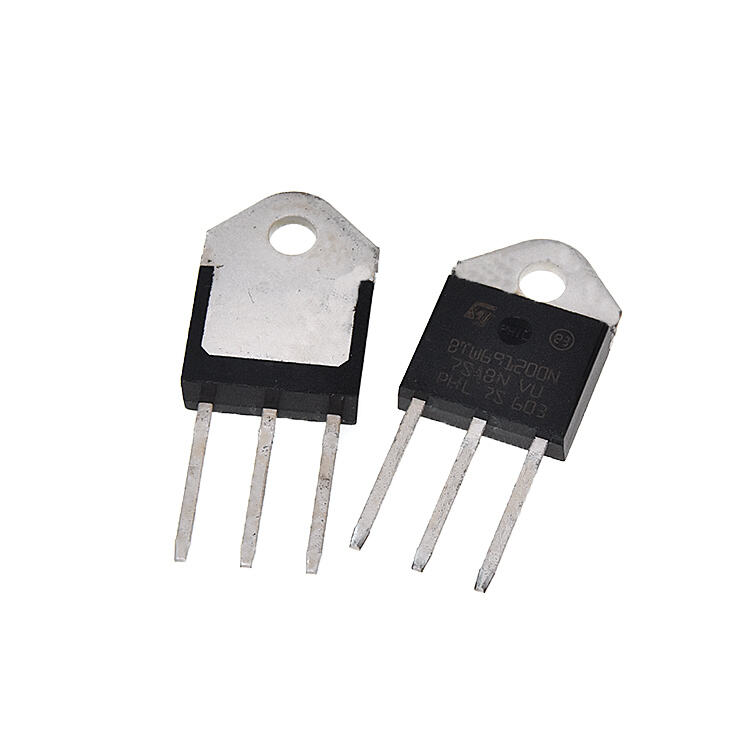
In the intricate symphony of electronics, where transistors sing in microseconds and capacitors hold brief memories of charge, there exists a quiet but powerful performer: the Thyristor. Often overlooked in favor of its flashier semiconductor siblings, the thyristor remains a backbone of modern power systems, quietly managing vast currents with the poise of an experienced conductor.
But what exactly is a thyristor—and why should we still care in an age dominated by silicon chips and nanoscale transistors?
The Anatomy of a Controlled Avalanche
At its core, a thyristor is a solid-state semiconductor device with four layers of alternating P- and N-type materials: PNPN. This makes it a three-junction device, and from the outside, it looks simple: three terminals — anode, cathode, and gate.
But simplicity ends at the surface. The thyristor behaves like a digital switch that can control huge amounts of power — from lighting up a city block to regulating motors in industrial machines — with just a tiny signal at the gate.
What makes it unique is its latching behavior: once turned on, it stays on even if the gate signal is removed, as long as the current through it remains above a certain threshold.
This is not just switching; it’s controlled avalanche. The moment the gate triggers conduction, a chain reaction of carrier injection and regeneration happens inside the device — like a miniature lightning storm captured in silicon.
The Origin Story: A Rocket Scientist’s Dream
The thyristor was born in the late 1950s, an era defined by rocket dreams and transistor revolutions. General Electric engineers were among the first to develop the device, initially calling it a “silicon controlled rectifier” (SCR).
Why “thyristor”? The name is a fusion of “thyratron” (a type of gas-filled tube it aimed to replace) and “transistor.” It was intended to be the best of both worlds — robust like vacuum tubes, but fast and reliable like transistors.
And it was. The thyristor quickly took over heavy-duty applications where power control mattered more than speed.
Power without the Drama: Industrial Superpowers
Thyristors are not flashy, but they are heroes in harsh environments. Some of their superpowers include:
High Voltage Tolerance: Thyristors can handle thousands of volts, ideal for HVDC (High Voltage Direct Current) transmission.
Massive Current Handling: They can switch hundreds of amps, making them perfect for motor drives, industrial heaters, and traction systems in trains.
Thermal Resilience: Compared to other semiconductor devices, thyristors are remarkably robust in high-temperature settings.
In the steel mills of Pittsburgh, in the electric trains of India, in the wind turbines of Denmark — somewhere, a thyristor is working, quietly, relentlessly.
Smart Control in a Binary World
A thyristor doesn’t play in the analog grey. It’s on or off. No halfway, no dithering.
But in this binary world, it’s surprisingly smart. Engineers use phase-angle control to modulate power — turning it on and off at precise times in the AC cycle, effectively “chopping” the waveform to reduce or increase power to a load.
This form of power control allows fine-tuned energy savings and thermal management in applications like:
Dimming theater lights
Soft-starting industrial motors
Controlling electric furnaces
It’s analog results from digital decisions — a philosophical paradox in every thyristor circuit.
The Flip Side: Limitations and Legacy
Despite its strengths, the thyristor has limitations:
Once on, it can’t turn off easily — unless the current naturally goes to zero (as in AC) or a forced commutation circuit is used.
Slow switching speeds compared to IGBTs or MOSFETs.
Limited in high-frequency applications, like modern DC-DC converters or RF circuits.
But that’s okay. Thyristors aren’t trying to be everything. They’ve found their niche — and they’ve held it for decades.
Beyond the SCR: Thyristor Family Tree
The original SCR was just the beginning. Over the years, many cousins emerged:
TRIAC: Like a bidirectional SCR — can control AC in both directions, used in light dimmers and appliance controls.
DIAC: A triggering device, often used to fire TRIACs.
GTO (Gate Turn-Off Thyristor): Can be turned off via the gate — offering more control.
IGCT and LASCR: Advanced versions used in high-speed and high-power systems.
Each variant carved out its role in the ever-expanding landscape of power electronics.
The Future of Thyristors: Still Relevant?
In a world now brimming with fast-switching MOSFETs, SiC, and GaN devices, it’s tempting to ask: Are thyristors obsolete?
The answer is no — just re-specialized.
In renewable energy systems, HVDC links, battery energy storage systems (BESS), and industrial-grade inverters, thyristors still offer unmatched reliability, ruggedness, and cost-effectiveness.
They’re not for your smartphone — they’re for your power grid.
Conclusion: The Invisible Giant
The thyristor may not dominate headlines, but it dominates power.
It is the invisible giant of the electrical world — silently handling megawatts of power, shrugging off surges, and dutifully operating in the background while the world obsesses over the next billion-transistor chip.
So next time a train moves, a wind turbine spins, or a factory lights up — tip your hat to the humble thyristor, the switch that refuses to be switched off from history.